
The AI your firm can actually adopt.
Four conditions every regulated firm needs before it can responsibly adopt AI: documents that never leave your control, answers that cite their sources, a vendor choice that doesn't concentrate risk, and a deployment you can defend to a regulator. Librarian is the on-premise architecture that satisfies all four.
Built for firms of 5 to 50 professionals. Deployed on your hardware. Documents, queries, and outputs never transmit to a vendor.
Four risks that are no longer hypothetical.
The 2024 conversation about AI in regulated industries focused on benefits. The 2026 conversation has shifted — because the risks have also been measured, in court, in regulatory filings, and in professional guidance.
Hallucination in work product
Sanctions for AI-fabricated citations now number in the hundreds across U.S. federal and state courts. Hallucination is an inherent property of current AI systems and cannot be eliminated. The firm's responsibility is to adopt tools that make hallucination detectable.
Confidentiality exposure through cloud inference
Cloud-based AI transmits documents to vendor servers for processing. Privacy policies and DPAs describe what the vendor promises. The architectural fact is that at processing time, the vendor has access to your privileged documents.
Regulatory and ethical exposure
The EU AI Act begins enforcement August 2026. Colorado's AI Act begins June 2026. Professional regulators are issuing formal AI guidance. None of it reduces the firm's documentation burden or the duty of care owed when using AI in client work.
Vendor dependency and lock-in
AI for regulated industries is a young market. Vendors have been acquired, pivoted, or absorbed. A firm integrated with a specific vendor's API and cloud is exposed to that vendor's business decisions in a way a firm running on its own hardware is not.
Three deployment patterns. Only one satisfies all four conditions.
A firm evaluating AI is not just choosing a vendor — it is choosing an architectural pattern. Cloud inference, hybrid, or on-premise. Each has a distinct data flow and risk profile.
Large risk surface, controlled by the vendor. Documents transmitted at rest and in use. 10–15 sub-processors typical.
Medium risk surface. Documents stored locally, but queries cross vendor infrastructure at every interaction.
Small risk surface, controlled by the firm. No data transmitted. Four scoped outbound connections, each disclosed.
Built around four architectural commitments.
Documents stay where they belong
Installed as a Windows application on your firm's hardware. Every stage — text extraction, indexing, AI inference, response synthesis — runs locally. No transmission of document content to any external system.
Every answer, traceable to a specific source
Source-bound answering. Every claim in a response is directly traceable to a specific passage in a specific document. Hallucinations become detectable rather than invisible.
A product the firm can adapt to itself
FORGE lets the firm train adapters on its own documents — without transmitting training data, and producing a model the firm owns in a standard format.
Built to be reviewed
Per-query audit trail, citation on every answer, EULA transparency statement aligned with EU AI Act Article 13, and full architectural documentation available for IT security review.
Everything your IT reviewer and managing partner will want.
All documents are free to download and share. No email gate, no sign-up required.
Architecture Whitepaper
The complete case for on-premise AI in regulated industries. Four risks, three architectures, Librarian as implementation, operational reality.
IT & Security One-Pager
For IT reviewers. What’s installed, what leaves your network, compliance posture, and the full architecture diagram.
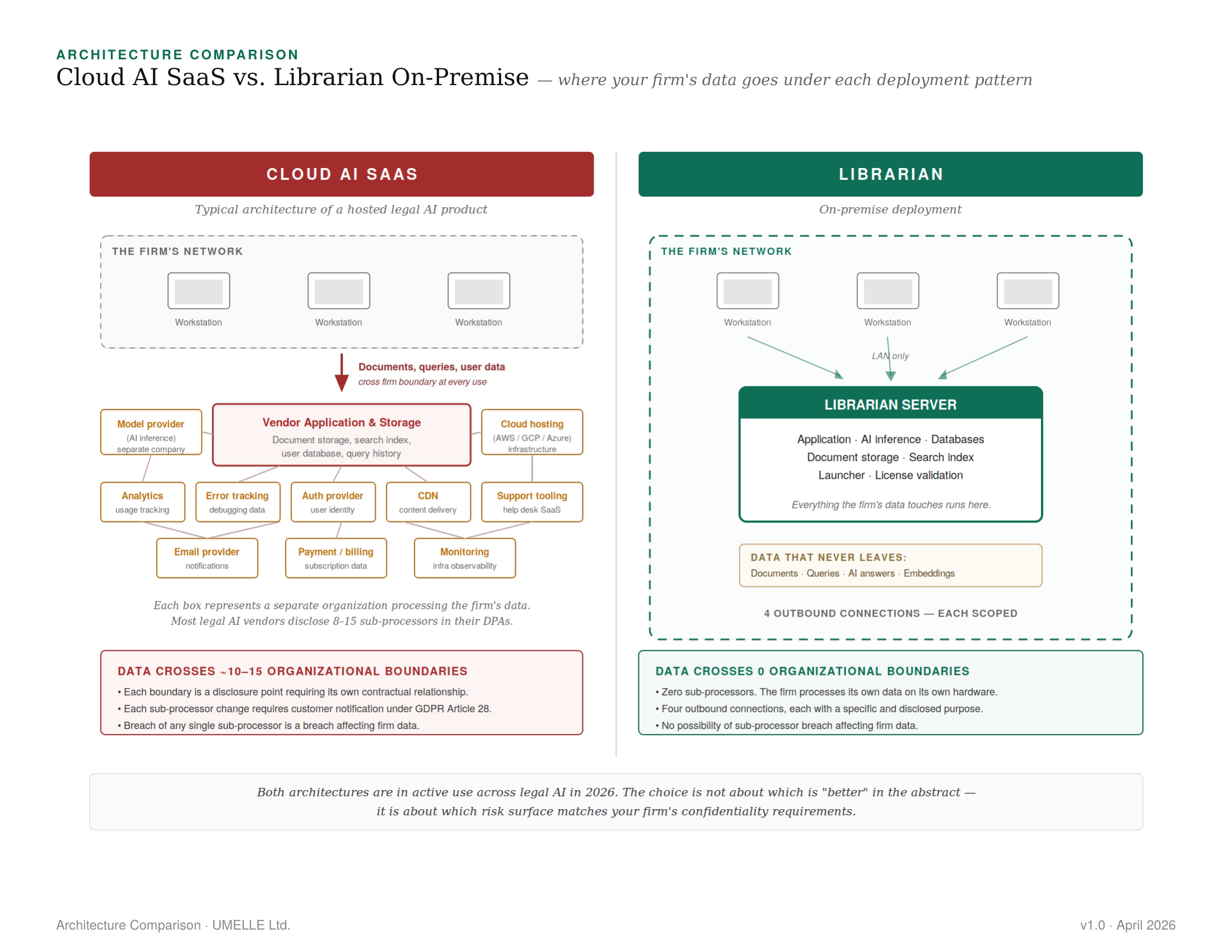
Architecture Comparison
Side-by-side: what a typical cloud AI vendor’s architecture looks like, vs. Librarian’s on-premise architecture.
What Happens If UMELLE Disappears
Vendor-continuity reference. What your firm retains, what continues working, and for how long — regardless of UMELLE’s corporate fate.
Firm and Firm+ tiers.
Firm
- Up to 15 users
- 48-hour response SLA
- Onboarding assistance
- IT & Security documentation package
Firm+
- Up to 30 users
- 24-hour response SLA
- Named support contact
- Priority onboarding
- Quarterly compliance review
Ready to review the architecture with your team?
Start with a free trial on your own hardware. Or talk to us about firm-tier deployment.